Back to the Office? A German-Belgian Comparison on Remote Work
Back to the office: what have we learned since Covid?
Remote work in Belgium and Germany has come a long way since 2020. What started as an emergency response to Covid has become an established feature of working life. In neither country do employees have a general right to work from home, yet many arrangements were put in place quickly during the pandemic, often without much thought given to their long-term consequences.
In Belgium, structural telework in the private sector is primarily governed by Collective Bargaining Agreement (CBA) No. 85 of 9 November 2005 and the Employment Contracts Act of 3 July 1978. A key feature is that structural telework is voluntary for both employer and employee. CBA No. 85 requires an individual written agreement addressing, among other things, the frequency of telework, required office presence, costs and, importantly for today's return-to-office discussions, the conditions for returning to the employer's premises.
In practice, many Covid-era arrangements were less carefully structured: an email, a general policy or an informal understanding sometimes replaced the required individual agreement. That does not make the arrangement legally irrelevant. The Belgian Court of Cassation confirmed that the absence of a written agreement does not prevent a relationship from qualifying as structural telework (Belgian Court of Cassation, 5 October 2020).
In Germany, the trajectory has been similar. Employers used generous home-office policies to attract talent, advance digitalisation and reduce office space. According to the German Federal Statistical Office, in 2025 one in four employees worked from home at least occasionally. A right to work from home arises only where a corresponding provision is included in the employment contract, a collective bargaining agreement or a works agreement. Depending on the type of instrument, such arrangements may be modified or terminated in different ways.
For employers now reconsidering their remote-work model, the starting point should therefore be to establish what was actually agreed, through which legal instrument, and how the arrangement has operated in practice.
Can employers simply require employees to return to the office?
In both countries, the answer depends on what was actually agreed and through which legal instrument. Neither German nor Belgian law grants employees a general right to work from home, but equally, an employer cannot simply disregard the contractual framework under which telework was introduced.
Where a return mechanism exists
Where the telework agreement includes a termination or revocation right, the employer may in principle rely on it. In Germany, the Regional Labour Court of Hamm held that a contractually agreed partial termination (Teilkündigung) of a home-office arrangement is not subject to the general protection against dismissal, since it concerns the place of work rather than the parties' principal contractual obligations (LAG Hamm, judgment of 16 March 2023 – 18 Sa 832/22). In Belgium, CBA No. 85 specifically requires the telework agreement to address the conditions and modalities of a return, including the applicable notice period. Where the parties have expressly agreed on such a mechanism, applying it will in principle amount to implementing the agreement rather than a unilateral contractual change.
Where no return mechanism exists
Without a termination or revocation right, a unilateral return-to-office instruction becomes significantly more difficult in both jurisdictions. In Germany, where no home-office arrangement was expressly agreed, the employer’s general right to give instructions (Weisungsrecht) under Section 106 of the Trade, Commerce and Industry Regulation Act (Gewerbeordnung) may apply, but even then the instruction must not be arbitrary: it must pursue a comprehensible operational purpose and be based on a proper balancing of interests (Arbeitsgericht Düsseldorf, judgment of 11 February 2026 – 3 Ca 6587/25). Where a contractual home-office right exists without a revocation clause, the employer may need to issue a formal notice of termination with an offer of amended terms (Änderungskündigung), triggering dismissal protection under the KSchG and works council participation rights.
Belgian law is similarly restrictive. Employment law does not allow the employer unilaterally to change an essential element of the employment contract, and the Court of Cassation has held that the place of work is, in principle, such an essential element (Belgian Court of Cassation, 26 January 2004). However, telework can, depending on the circumstances, be merely a modality of work organisation. The assessment is fact-specific: if an employee accepted a position precisely because homeworking days were guaranteed, this strengthens the argument that the arrangement forms part of the essential working conditions.
What about years of telework in practice?
In Germany, the betriebliche Übung (established company practice) may give rise to a contractual commitment where an employee has worked from home over a prolonged period without an explicit agreement: under the Federal Labour Court's approach, repeated conduct by the employer may bind it if employees could objectively understand that the arrangement would continue. A double written-form clause (doppelte Schriftformklausel) may be designed to prevent this. Such a clause provides not only that contractual amendments must be made in writing, but also that any waiver or amendment of the written-form requirement itself must be made in writing. It may therefore be designed to prevent an established company practice from arising. However, its effectiveness may in turn be limited by German law on standard terms and the priority of individually negotiated agreements.
Belgian law has no exact equivalent, but a longstanding practice cannot be ignored. The parties’ actual conduct may be relevant in determining the content of the arrangement, particularly in light of the Court of Cassation’s confirmation that structural telework may exist despite the absence of a written agreement under CBA No. 85.
Employers in both countries should therefore assess the full picture (contracts, addenda, CBAs, policies, correspondence and actual practice) rather than relying exclusively on the formal label attached to the arrangement.
What role do employee representatives play?
In Germany, the works council (Betriebsrat) has significant co-determination rights. A return to the office may qualify as a transfer (Versetzung) within the meaning of Section 95(3) of the Works Constitution Act (Betriebsverfassungsgesetz, BetrVG), requiring consent under Section 99(1) BetrVG. In addition, since 2021, Section 87(1) No. 14 BetrVG provides a specific basis for co-determination on how mobile work is structured. Where home-office work rests on a collective bargaining agreement (Tarifvertrag), the employer cannot unilaterally end the arrangement. Where it rests on a works agreement (Betriebsvereinbarung), termination under Section 77(5) BetrVG may be possible, but any statutory after-effect (Nachwirkung) under Section 77(6) BetrVG must be considered insofar as matters subject to mandatory co-determination are concerned.
Belgian law does not give the works council a veto, but imposes important information and consultation obligations. Under the Act of 20 September 1948 and CBA No. 9, the works council must be informed of measures that may modify working conditions. CBA No. 5 requires the trade union delegation to be informed in advance of relevant changes, and CBA No. 85 separately requires consultation on the introduction of telework. A broad return-to-office programme should therefore be reviewed from this collective-relations perspective.
Scaling back and individual exceptions
Neither German nor Belgian law prescribes a single statutory notice period for scaling back home-office arrangements. In both countries, the applicable notice depends on the legal basis of the existing arrangement. In Germany, where no agreement can be reached with the employee, a notice of termination with an offer of amended terms (Änderungskündigung) may be considered as a last resort, subject to the requirements of the Protection Against Dismissal Act and works council participation. In Belgium, the parties are expected to regulate the notice period in the telework agreement itself; where they have not done so, a reasonable transition period is advisable.
Employers in both jurisdictions must also consider whether individual circumstances justify an exception from a general return-to-office policy. In Germany, the General Act on Equal Treatment (AGG) requires that selection criteria do not result in unlawful discrimination, and decisions should be documented and objectively justified. In Belgium, anti-discrimination legislation similarly applies; case law has found discrimination where telework accommodation was withdrawn from an employee with a disability (Brussels Labour Court of Appeal, 18 December 2012, ECLI:BE:CTBRL:2012:ARR.20121218.7; President of the Liège Labour Court, 9 March 2018, RG 17/22/C). Belgian employees with caregiving responsibilities may additionally rely on CBA No. 162 to request a flexible working arrangement, including telework.
Cross-border remote work: the Belgium-Germany example
Cross-border telework adds another layer of complexity.
Consider an employee who lives in Belgium, works for a German employer and works three days per week in Germany and two days from home in Belgium. For social-security purposes, the employee habitually works in two Member States. Regulation (EC) No. 883/2004 and Implementing Regulation (EC) No. 987/2009 therefore apply.
Under the ordinary rules for activities pursued in two or more Member States, an employee who performs a substantial part of the activity in the Member State of residence is, in principle, subject to the social-security legislation of that state. A share of at least 25% of working time and/or remuneration is the relevant indicator.
For an employee living in Belgium and working for a German employer, the basic position can be summarised as follows:
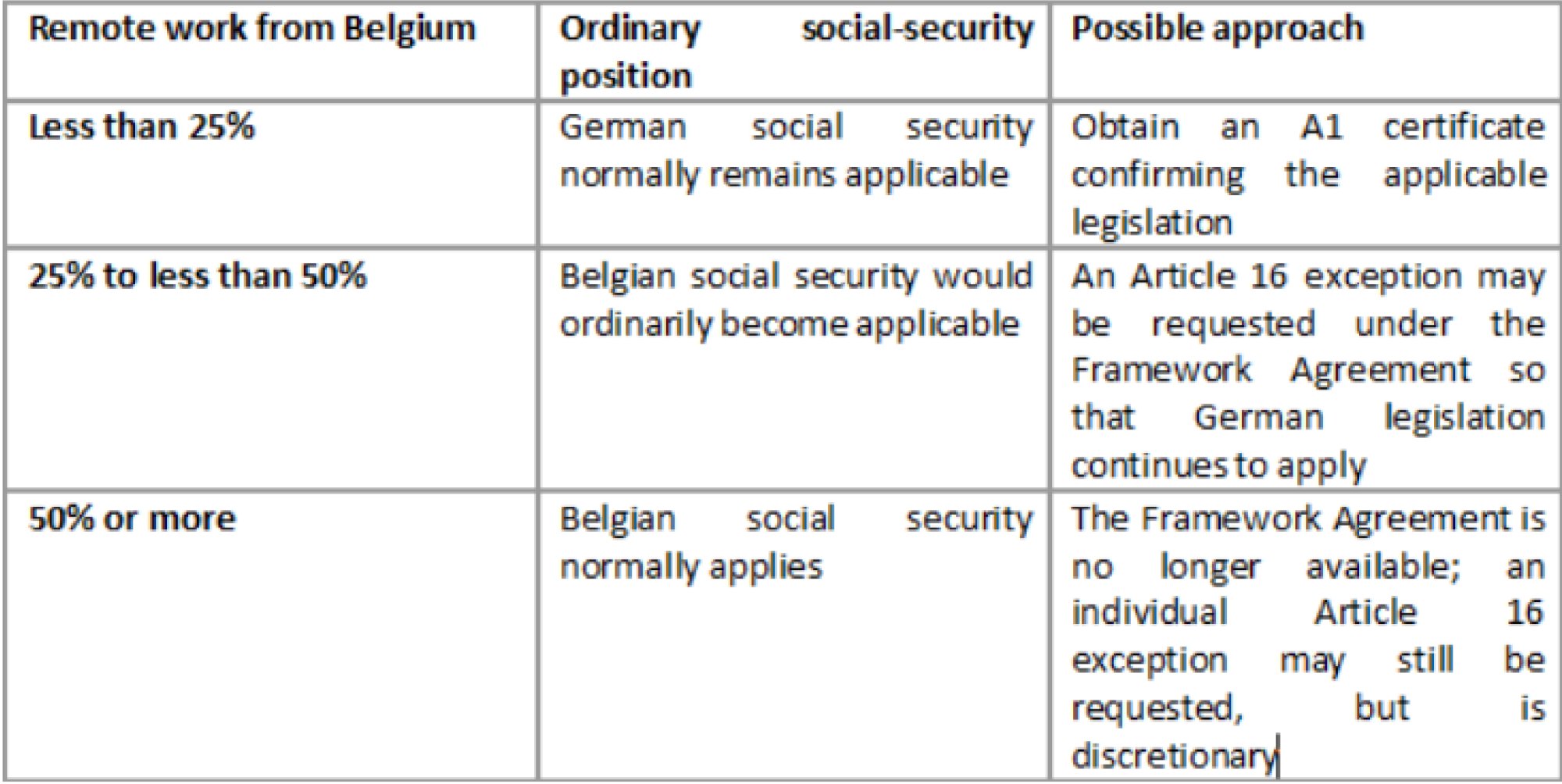
The same reasoning applies in reverse to an employee living and working in Germany for a Belgian employer. In this case, the employer must participate in the German social security registration system, regardless of whether it operates a business in Germany at all. This involves a significant administrative burden, and violations can result in substantial back payments and fines. A payroll provider can help manage these obligations. Some German health insurance funds also offer services that are similar to payroll support for foreign employers. However, risks remain, particularly where contributions are transferred via the employee: if the employee fails to pass them on correctly or on time, the employer may still face contribution arrears and enforcement risks.
What should employers do now?
- Map the legal basis for existing telework: employment contract, CBA No. 85 addendum, enterprise or sector CBA in Belgium, workplace agreements, work rules, policies and correspondence.
- Check the return mechanism before announcing a change: who may terminate or reduce telework, under which conditions and subject to what notice.
- Do not assume that an undocumented Covid-era arrangement is legally irrelevant: in Belgium, structural telework can exist even without the written agreement required by CBA No. 85.
- Assess how important telework is to the individual contractual relationship: in some cases, it may be merely an organisational modality; in others, the place of work may be an essential contractual term.
- Review collective consultation requirements: in particular the role of the works council and trade union delegation and whether a CBA, a works agreement (Betriebsvereinbarung) or the work rules need to be amended.
- Provide a sensible transition period where the applicable documents do not contain a clear notice mechanism.
- Develop consistent and transparent selection criteria. Employers should examine whether comparable employees are being treated differently without an objective reason, and should consider special individual agreements as well as part-time employees and employees with special work schedules. Risks of discrimination under the German AGG and Belgian discrimination legislation must be assessed, and decisions should be documented and supported by objective justifications.
- Require prior approval for cross-border telework: the social-security and tax implications should be assessed before an employee starts regularly working from another country.
- Track the percentage of working time performed abroad and obtain the appropriate A1 documentation.
- Put future arrangements in writing: expressly addressing frequency, permitted locations, office attendance, return rights, notice periods and cross-border work.
AUTHORS
Dr. Luise Brunk is an Attorney at Law at addworx, the German member of Ellint. She is espesialized on Social law (company audits, status determination procedures), New work models (mobile working, workation)
Labour and employment contract law, Dismissal protection law, Works constitution law,
She studied in Freiburg and Paris and Doctorate on 2020.
Victor Wouters was admitted to the bar in September 2024. He holds a master’s degree in law (2024) from KULeuven, as well as a master’s degree in philosophy (2023) from the same university. At Sotra, he handles cases related to all aspects of employment law in the private sector. Victor is Dutch-speaking and is fluent in French and English.