In sobre The Minimum Wage: A Perverse Incentive for the Mexican Labor Market?
The minimum wage has been subject to no fewer than eight increases throughout the so-called Fourth Transformation, all of them significant. In the final stretch of President Enrique Peña Nieto's tenure, the daily amount was eighty-eight pesos; since then, double-digit increases have become the norm, and this appears likely to persist. We could assert that the economy "has withstood" these increases, debunking the myth of the increase fueling inflation. The increases allow for some repayment of a social debt to the Mexican working class. But we can also say that, in terms of minimum wage increases, it is neither the promised paradise nor the predicted hell.
The minimum wage was 37% of the average wage in 2014, and Morena has increased it to more than 75%. This alleviated poverty; the wages of informal workers have also increased, since the new minimum wage makes very low wages less socially acceptable. But it represents a hindrance to formalization and growth.
According to data from the National Institute of Statistics and Geography (INEGI), specifically the National Survey of Occupation and Employment (ENOE) and the National Minimum Wage Commission (CONASAMI), both published monthly, the number of people earning the minimum wage has almost quadrupled between 2018 and 2025, rising from 4.5 million to 16.2 million. The percentage of the population earning the minimum wage in Mexico has increased from 16% in 2015 to 26.8% in 2026 (an increase of over 10 points). One might wonder, what has become of the population group earning more than one or even two minimum wages? This group has plummeted, falling from 8 million in 2018 to 2.7 million in 2025.
There is a first reading of these data to reflect on: Employment in Mexico is almost full (we average rates of almost 98% since the 4T) but it is precarious; more people with minimum wage means that more heads of household cannot manage their work, support their offspring (assuming families of three people, the food basket plus non-food items is 14 thousand pesos and the minimum wage is close to 10 thousand).
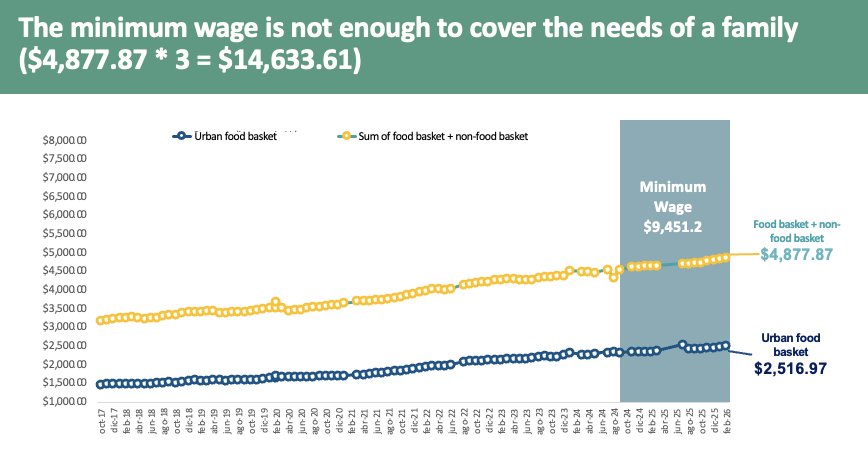
The Mexican business and employer class must move beyond the "Minimum Wage Garden" (this includes not only blue-collar workers but also domestic workers in our homes, for example). The concentration of employment at or below the minimum wage reveals a structural phenomenon: the Mexican labor market absorbs labor but does not integrate it into productivity or protection schemes. We are not facing an economy that does not employ, but rather an economy that perhaps employs poorly.
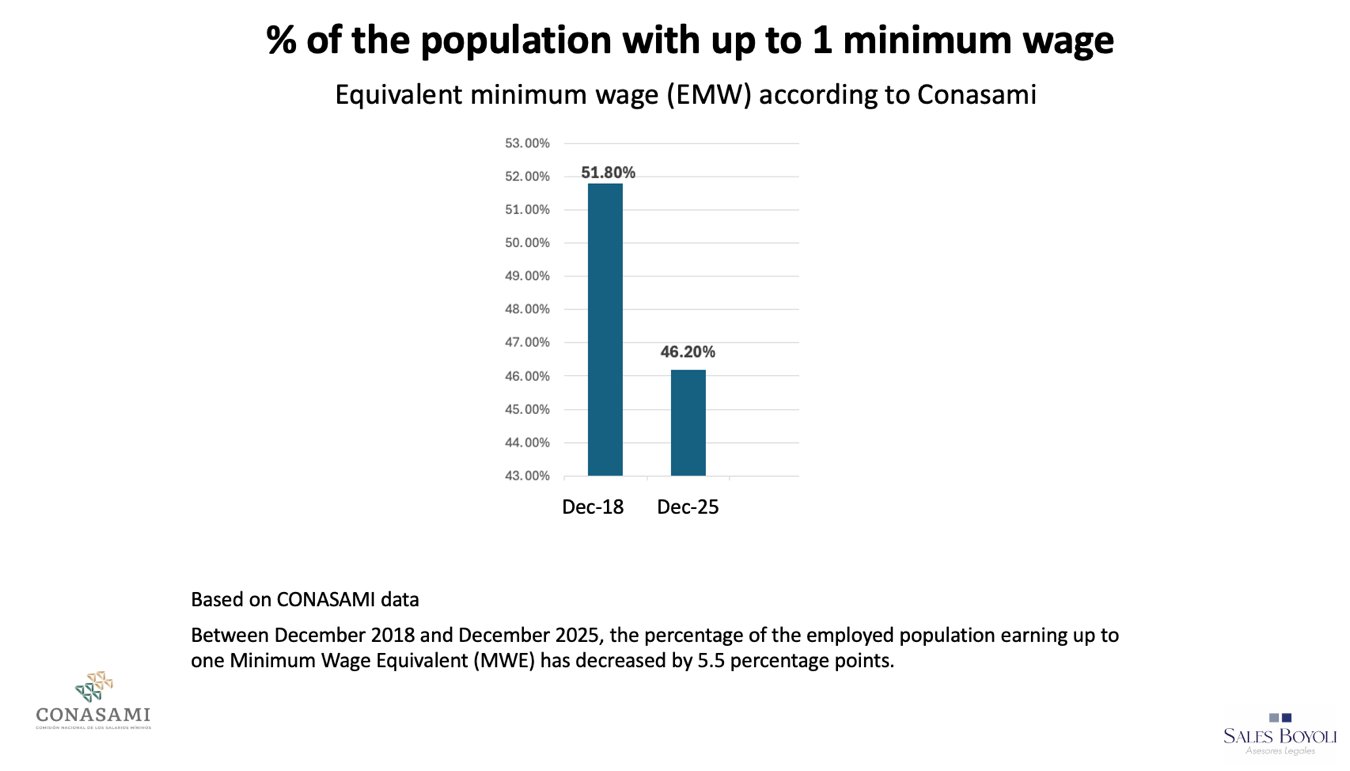
In its latest publication on the state of the economy and the labor market, CONASAMI launched a novel measurement: the "Equivalent Minimum Wage," stating the following: "To compare the employed population by minimum wage ranges, INEGI developed the methodology of equivalent minimum wages. In short, the method consists of converting the minimum wage in effect at the time the data was collected to pesos of each historical period, adjusting for the National Consumer Price Index (INPC); this allows for comparisons over time." With this minimum wage variable between December 2018 and December 2025, the percentage of the employed population earning up to the equivalent minimum wage (SME) has decreased by 5.5 percentage points. This exercise reminded me of a British prime minister who said that in politics there are “little lies, big lies, and statistics.”
AUTHOR
Jorge Sales is widely recognized as one of the most influential labor lawyers in Mexico and the broader T-MEC (USMCA) region. As a leading expert in labor and union dispute resolution, he has played a pivotal role in fostering labor peace and stability across Mexico, the United States, and Canada—particularly in strategic sectors such as nearshoring and specialized service outsourcing.
Jorge has been instrumental in handling high-profile union negotiations, including key cases under the Rapid Response Labor Mechanism initiated by the U.S. government. Notably, he was the first lawyer in Mexico to manage a U.S.-filed labor complaint involving collective bargaining in the pulp and paper industry. His deep knowledge of the Mexican labor market, combined with a strong reputation among labor authorities, makes him a reference point in both national and international employment law circles.