Business trips and working time: An analysis from a French and Belgian perspective
What is “working time” in your respective jurisdictions?
FRANCE
Effective working time is defined by article L. 3121-1 of the French Labour Code as the periods during which the employee is at the disposal of the employer, follows their instructions and cannot freely attend to personal matters.
This definition is more restrictive than that arising from Directives n°93/104/EC of 23 November 1993 and n°2003/88/EC of 4 November 2003, according to which working time is "any period during which the worker is at work, at the employer's disposal and carrying out his activity or duties ".
Whereas the European Union texts essentially retain the criteria of availability and productive activity, French law focuses on the combination of availability, subordination and the absence of freedom to engage in any activity other than work.
BELGIUM
The legal definition of working time is relatively concise. It refers to the period during which the employee is at the employer’s disposal.
Because of this concise definition, discussions frequently arise as to whether specific periods — such as on-call duties or travel time — qualify as time during which the employee is genuinely at the employer’s disposal.
In European and Belgian case law, the decisive criterion is the degree of constraint imposed on the employee during that period. Relevant questions include:
Can the employee freely use the time for personal purposes?
Does the employee have discretion over when to perform the activity?
Is the employee required to remain available for the employer?
The greater the restrictions on personal freedom, the more likely the period will qualify as working time.
Is commuting time during a business trip considered working time?
FRANCE
Principle: Travel time to the place of work is not considered actual working time (French Labor Code, Art. L. 3121-4, paragraph 1).
Exception: This time becomes actual working time when the employee performs a professional task during this travel, such as drafting documents, participating in a videoconference, or preparing for a meeting.
For example, travel time was classified as effective working time where the employee claimed, without being challenged by the employer, that while driving he was required to schedule appointments, make and receive calls with various contacts using his professional mobile phone and the hands-free system installed in the company vehicle provided to him. He also had to frequently stay overnight away from home in order to resume his duties the following day (French Supreme Court, 23 November 2022, No. 20-21.924).
By contrast, the mere fact that the employer retrospectively monitored the length of the journeys, or that the employee occasionally had to stay overnight (“evening stopovers”) to avoid an excessively long trip at the end of the day, is not sufficient to establish that the employee was at the employer’s disposal and unable to attend to personal activities during travel time (French Supreme Court, 25 October 2023, No. 20-22.800)
Burden of proof: The employee bears the burden of proving that the travail involved an unusual or exceptional period (French Supreme Court, May 15, 2013, No. 11-28.749).
Consequences: When travel time is not actual working time, it is not taken into account for the calculation of overtime, nor included in the calculation of maximum working hours, and cannot be used to argue a violation of the legal requirement for the 11 hours of daily rest between two working days.
Practical example:
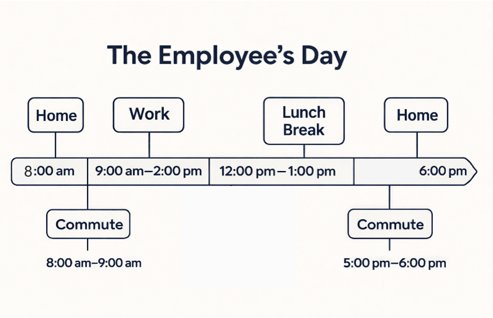
Calculation:
The 14 hour travel period must be compared with the employee’s normal daily schedule
- 1 hour corresponds to the usual commuting time
- 7 hours correspond to the normal daily working time
- 1 hour corresponds to the lunch break
Results: 14 hours – 9 hours = 5 hours of additional travel time
These 5 hours must give rise to compensation, either in the form of financial payment or equivalent rest time. They do not qualify as effective working time and do not entitle the employee to overtime pay. Nevertheless, the employee continues to receive their usual remuneration, with no loss of pay for their 7 daily working hours.
But, if, during the trip, the employee has to work more than 7 hours (preparation of meeting, meeting attendance etc…), these specific hours have to be paid as overtime.
BELGIUM
As a general rule, travel undertaken at the employer’s request in the context of a business trip qualifies as working time, at least where it entails certain constraints on the employee’s freedom.
This is clearly the case when the employer instructs the employee to perform work during travel (for example, preparing a meeting during a flight). In such circumstances, the employee is performing work, possibly outside normal working hours.
If the employee remains inactive during travel, the assessment may differ:
- An employee who must drive several hours to attend a professional meeting is subject to significant constraints and cannot freely use that time for personal purposes. In principle, such travel time will therefore qualify as working time. The situation may differ, however, for a colleague who merely joins a carpool as a passenger, depending on the degree of freedom retained.
- In the case of air travel, the analysis could be more nuanced. An employee travelling by plane may, in principle, use the time freely (e.g. reading, watching a film) and is not realistically available to respond to the employer or clients. Nevertheless, certain case law has considered that air travel may substantially restrict personal freedom and therefore constitute working time (see, for example, EFTA Court, 15 July 2021, Case E-11/20, E.O. Sverrisson v The Icelandic State).
In practice, employers and employees often adopt a pragmatic approach. Travel during normal working hours is usually treated as working time. Travel outside normal working hours is often not treated as such. In reality, the key issue is often not the qualification as working time, but whether the employee is entitled to compensation. If no compensation is due (see question 4 below), the qualification becomes less decisive in practice.
Which on-site activities qualify as working time?
FRANCE
The mere fact that an employee is travelling abroad and therefore away from their home is not, in itself, sufficient to infer that the employee remains permanently at the employer’s disposal throughout the entire stay and is unable to attend to personal activities (French Supreme Court, 20 December 2006, No. 04-48.525).
Similarly, the fact that an employee remains reachable during a business trip is not enough to characterise the time as effective working time (French Supreme Court, 13 March 2024, No. 22-11.708).
In addition, journeys made by an employee during a multi-day assignment to travel to their hotel, stay overnight and return the following day do not constitute travel between two workplaces. Rather, they are considered ordinary business travel time and are not treated as effective working time (French Supreme Court, 7 June 2023, No. 21-22.445). The position would differ only if it were established that, during those periods, the employee remained under the employer’s authority and was not free to attend to personal activities.
In any event, a business trip may not result in any loss of salary. For example, if an employee normally works 7 hours per day and spends 4 days on a professional assignment, they must be paid on the basis of at least 28 hours (7 hours × 4 days).
BELGIUM
The mere fact that an employee is away from home does not mean that the entire period abroad qualifies as working time. The obligation to stay several nights abroad during a business trip does not, in itself, change this assessment.
Likewise, the expectation that an employee remains reachable by telephone does not automatically mean that the entire period counts as working time.
Time spent performing professional tasks on site on the other hand clearly qualifies as working time. More informal moments — such as social activities or downtime — do not qualify as working time, unless they involve professional obligations, for example meetings or contacts with clients at the employer’s request.
Is there some form of “inconvenience compensation”?
FRANCE
If the travel time exceeds the employee’s normal commuting time between home and the usual place of work, the excess must give rise to compensation, either in the form of compensatory rest or financial payment. However, such time is not actual working time (French Labour Code, Article. L. 3121-4, paragraph 2).
The arrangements for this compensation are determined by a company collective agreement, or failing that, by a collective bargaining agreement (French Labour Code, Article. L. 3121-7). In the absence of any collective agreement, the compensation is set unilaterally by the employer after consultation of the works council (French Labour Code, Article. L. 3121-8).
The guiding principle adopted by the French legislature is therefore the exclusion of professional travel time from the definition of actual working time. This general principle is subject to two safeguards:
Compensation in rest or money must be provided where professional travel time exceeds the normal commuting time between home and the usual workplace.
The portion of professional travel time that coincides with normal working hours must not result in any loss of salary.
Employees working under a working time in days scheme are not excluded from all statutory and regulatory provisions relating to working time. Article L. 3121-62 of the French Labour Code merely provides that they are not subject to the rules governing maximum daily working time, maximum weekly working time, or the statutory 35-hour working week rest right. No provision excludes them from the right to compensation where professional obligations lead to travel time exceeding their normal commute.
Moreover, excluding them from such compensation could amount to a breach of the principle of equal treatment, since they are subject to the same constraints as their colleagues when their travel time is extended for professional reasons.
BELGIUM
As a general principle, hours worked beyond normal working hours and exceeding applicable daily or weekly limits must be compensated through overtime pay and compensatory rest.
In practice, however, employees who frequently travel for business are often excluded from certain mandatory working time rules. In such cases, overtime may still constitute working time, but it does not necessarily give rise to additional compensation. This is typically the case for certain commercial, managerial or technical functions.
In addition to statutory rights, it is important to verify whether collective agreements provide for specific compensation. At sector or company level, a lump-sum premium may be granted to compensate for the inconvenience of being away from home.
Finally, inactive periods that qualify as working time during business trips may, in principle, be remunerated differently from active working time. Neither European nor Belgian legislation prohibits differentiated remuneration for different categories of working time.
However, since remuneration in Belgium is generally determined by sectoral pay scales, individual employers will often have limited flexibility to introduce alternative remuneration schemes, due to the primacy of higher-ranking sectoral rules.
AUTHORS
Claire Chesneau. Associate at MGG Legal. She is member of the Paris Bar, she has been practising employment law since September 2013. Claire advises French and international companies of all sizes. She advises her clients and regularly pleads before the courts. She has built a genuine relationship of trust with her clients, whom she enjoys assisting on a daily basis.
Karel Devloo is Partner at Sotra. He joined the firm in 2018. He was admitted to the Brussels Bar in January 2015. Karel holds a Master's degree in law from Ghent University (2013) and a Master's degree in political science from the same university (2010).He deals with individual and collective labour law cases. He is a regular speaker at seminars on social law. Karel is a Dutch speaker. He is fluent in English, French and Spanish.